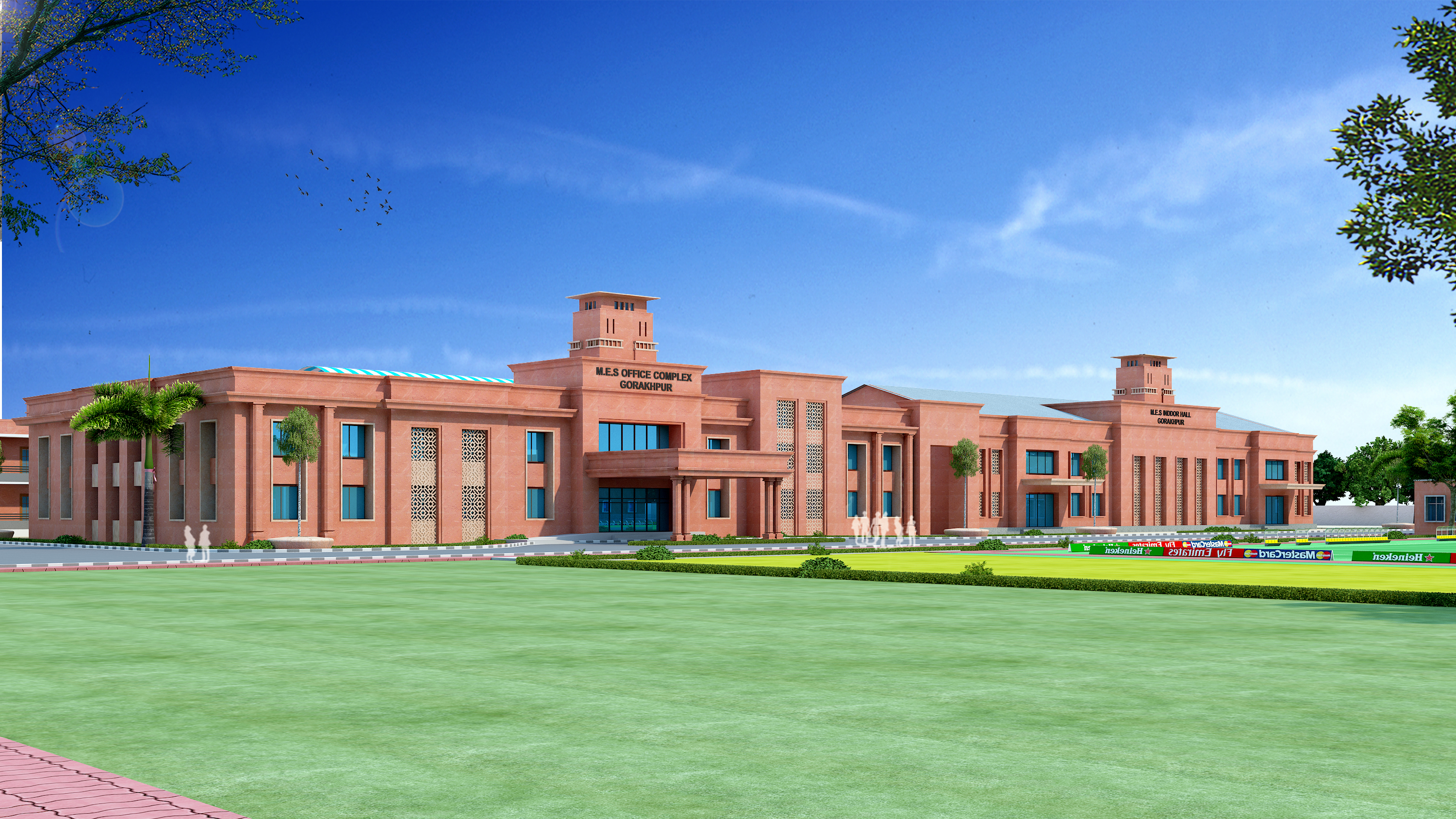
MES Officers Complex
MES Officers Complex at Gorakhpur, Uttar Pradesh
Project Facts
- Area: 45 Acres
- Budget: INR 100 Crores
- Project year: 2025
- Client: UPPWD
- Location: Gorakhpur, Uttar Pradesh
Institutional architecture operates at the intersection of precision, efficiency, and identity. When designed thoughtfully, such environments go beyond mere functionality—they embody structure, hierarchy, and purpose. In an era where infrastructure must respond to both operational demands and evolving human needs, the design of administrative and service campuses requires a deeply integrated approach.
A recent design exploration undertaken by ARCH-EN DESIGN exemplifies this philosophy through the planning of a comprehensive institutional campus. Developed as a multi-layered environment, the project integrates administrative offices, residential facilities, training infrastructure, and essential support services into a unified and highly organized ecosystem.
At the core of the design lies a strong emphasis on zoning and hierarchy. The master plan is structured to clearly distinguish between public, semi-public, and restricted domains. Administrative blocks are positioned to ensure accessibility and visibility, while residential areas are carefully buffered to provide privacy and comfort. Support infrastructure—ranging from storage facilities and garages to utility buildings—is seamlessly embedded into the overall layout, ensuring operational efficiency without disrupting the spatial order.
Circulation plays a critical role in shaping the experience of the campus. Wide internal roads, clear access hierarchies, and well-defined entry points establish a logical flow of movement. The planning ensures that vehicular and pedestrian pathways remain distinct yet interconnected, reducing conflict points while enhancing usability. This clarity of movement is essential in institutional environments where efficiency and security must coexist.
The architectural language is guided by pragmatism and clarity. Buildings are conceived with simple, robust geometries that allow for flexibility, scalability, and ease of construction. Large floor plates and modular planning systems ensure adaptability for evolving requirements, while internal layouts prioritize daylight, ventilation, and spatial efficiency. Central atrium spaces and corridors act as organizing elements, bringing light and openness into otherwise functional environments.
Residential planning within the campus reflects a parallel narrative of comfort and community. Housing units are designed with a balance of privacy and interaction, featuring efficient layouts, natural ventilation, and shared circulation cores. The arrangement of residential blocks fosters a sense of neighborhood while maintaining alignment with the larger institutional framework.
Recreational and open spaces are strategically integrated to enhance livability. Sports facilities, landscaped zones, and buffer greens not only improve the environmental quality of the campus but also contribute to the well-being of its users. These elements transform the campus from a purely functional entity into a holistic living and working environment.
Infrastructure planning is equally robust, with dedicated provisions for utilities, storage, and service areas. The inclusion of specialized structures such as hangars, equipment stores, and training facilities highlights the importance of operational readiness and long-term resilience. Each component is designed to function independently while contributing to the overall system.
What emerges is a campus that is not defined by individual buildings, but by the relationships between them. The strength of the design lies in its ability to organize complexity into clarity—creating a built environment that is efficient, adaptable, and enduring.
At ARCH-EN DESIGN, we believe that institutional architecture must reflect more than function—it must communicate purpose, discipline, and vision. Through integrated planning, contextual sensitivity, and design precision, we continue to shape environments that serve both immediate needs and future aspirations.