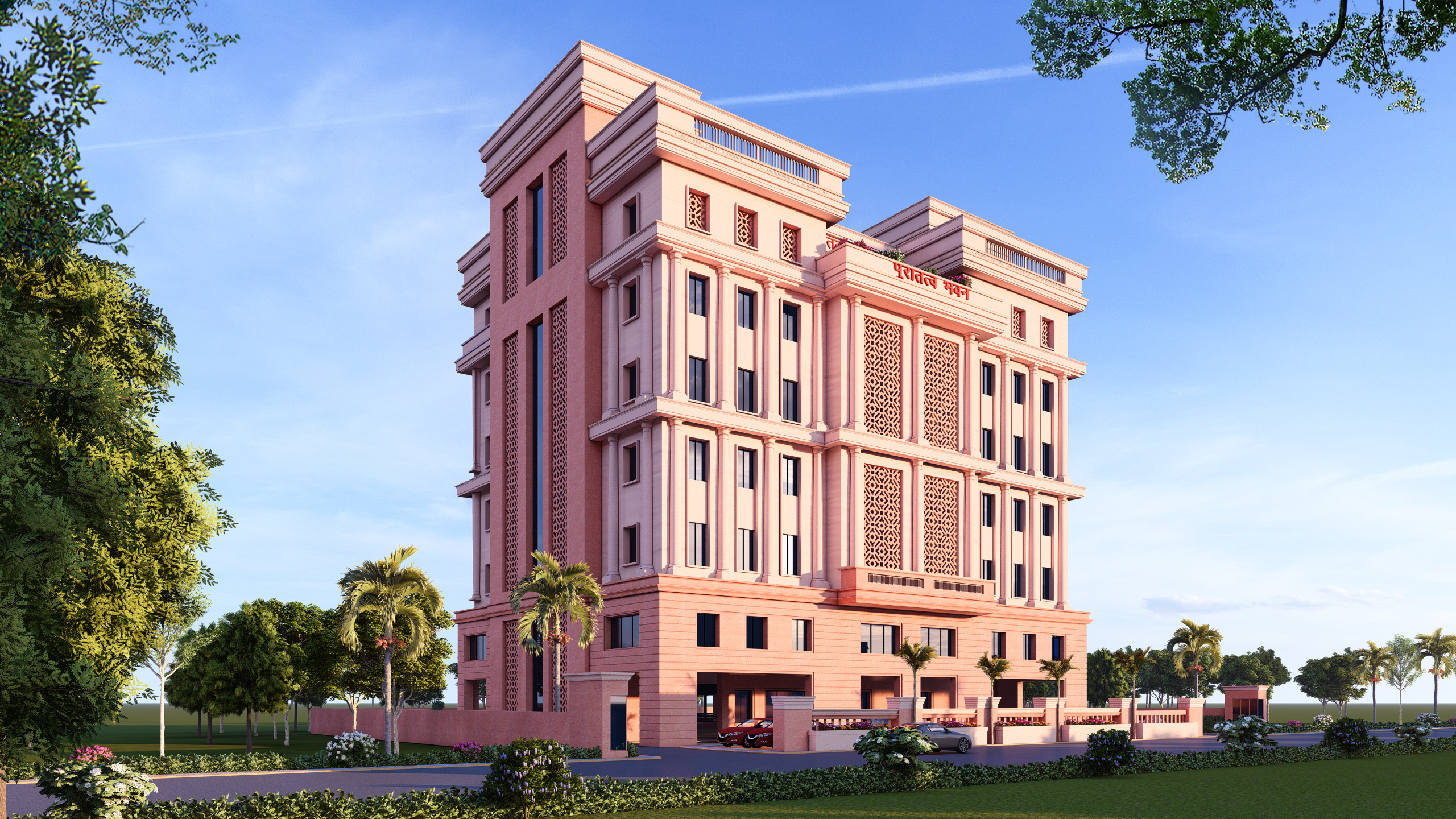
Puratatva Bhawan
A contemporary cultural landmark in Patna that seamlessly blends administrative functionality with architectural heritage, expressed through a refined façade, structured planning, and timeless design language.
Project Facts
- Area: 2 Acres
- Budget: INR 70 Crores
- Project year: 2028
- Client: BCD Patna
- Location: Patna, Bihar
The proposed Puratatva Bhawan in Patna is envisioned as a landmark institutional building that reflects cultural depth while addressing contemporary administrative and functional requirements. Designed as a dedicated facility for archaeological and heritage-related activities, the project integrates office spaces with exhibition and public interface areas, creating a holistic environment that bridges governance and cultural engagement.
The planning strategy is rooted in clarity and efficiency, with a strong emphasis on zoning and circulation. The building is organized vertically, accommodating administrative offices, directorate spaces, and support functions across multiple levels, while public-oriented functions such as exhibition areas, reception, and visitor amenities are placed at accessible levels. The inclusion of basements ensures efficient parking and service management, allowing the ground plane to remain open, organized, and pedestrian-friendly.
Architecturally, the building adopts a contemporary institutional language infused with contextual and cultural references. The façade is articulated through a structured grid of vertical elements and recessed panels, complemented by intricately designed jaali patterns that draw inspiration from traditional Indian architectural motifs. This combination creates a façade that is both visually rich and climatically responsive, allowing filtered light into the interiors while enhancing the building’s identity.
The composition emphasizes symmetry and proportion, lending the building a strong and dignified presence. Projecting volumes, framed openings, and layered façade elements introduce depth and hierarchy, while the use of a warm material palette reinforces its cultural association. The entrance is designed as a prominent architectural gesture, establishing a clear and formal arrival sequence that aligns with the institutional nature of the project.
Internally, the building accommodates a diverse range of functions including open workspaces, cabins, conference facilities, museum areas, and specialized labs, ensuring flexibility and adaptability for future needs. Upper levels incorporate additional amenities such as conference halls, lounges, and terrace gardens, enhancing the usability and experience of the building environment.
The design also integrates sustainable and user-centric features, including natural lighting strategies, landscaped surroundings, and efficient service planning. The overall approach ensures that the building not only performs as an administrative hub but also stands as a representation of cultural continuity and architectural refinement.