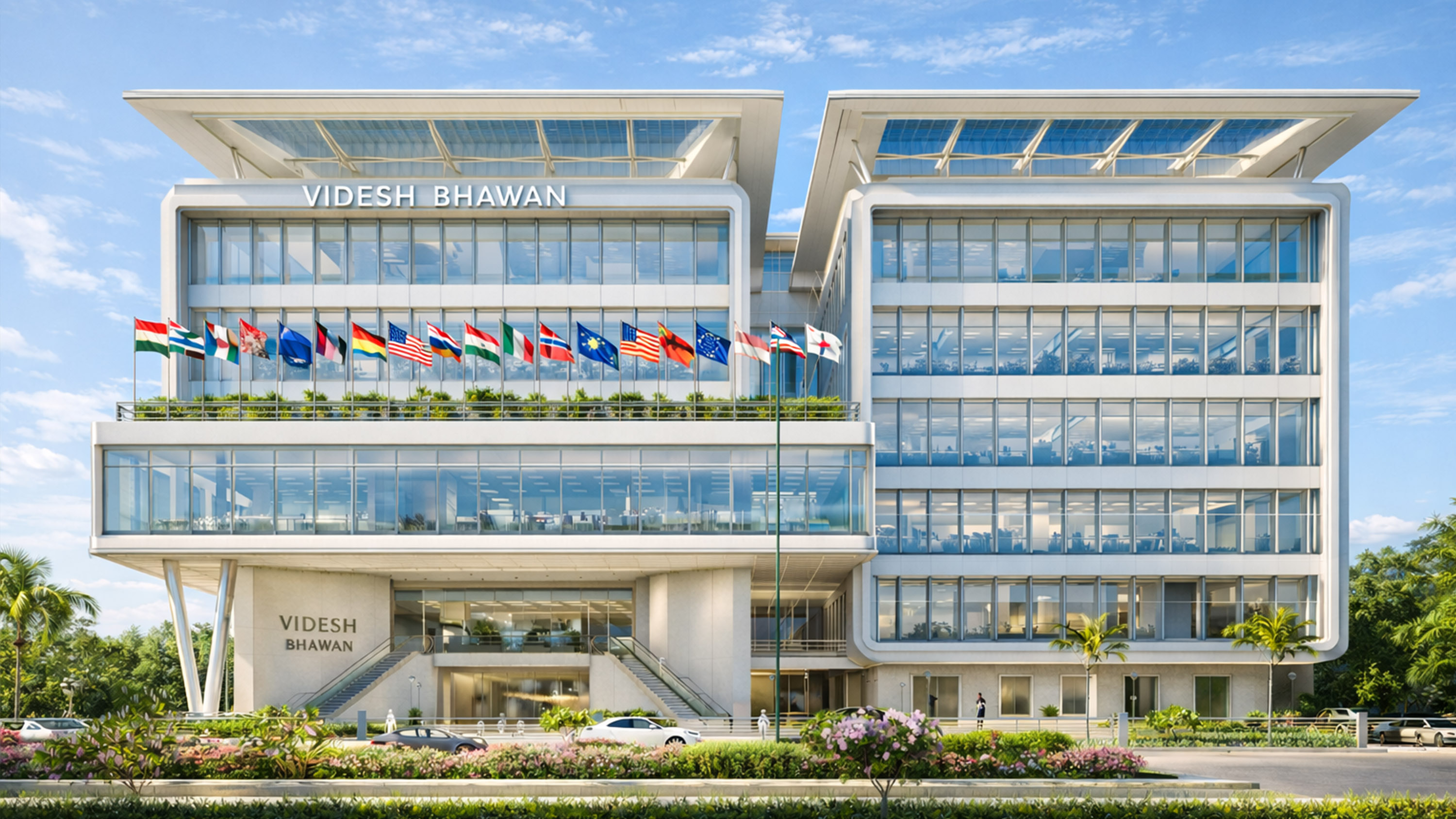
Videsh Bhawan
A Diplomatic Gateway: A Contemporary Institutional Landmark
Project Facts
- Area: 5 Acres
- Budget: INR 200 Crores
- Project year: 2027
- Client: MEA
- Location: Bihar
Conceived as a contemporary institutional landmark, this project redefines the role of civic architecture as an interface between governance and the public realm. The design brings together multiple administrative functions within a singular, cohesive built form, creating a unified identity that is both legible and symbolic. Rather than operating as a conventional office building, the architecture positions itself as a gateway—representing institutional presence while facilitating seamless public interaction.
Located along a prominent urban corridor, the building responds to its context through a carefully calibrated balance of visibility, accessibility, and control. The massing strategy elevates primary built volumes above a porous ground plane, establishing a shaded and open civic threshold. This gesture allows the building to engage with the city at a human scale, creating an inviting frontage while maintaining necessary security protocols.
The architectural language is defined by strong, framed volumes that articulate institutional clarity and stability. A deliberate composition of horizontal masses and structured geometry creates a sense of balance and permanence, reflecting the dual nature of public interface and administrative control. Circulation zones are expressed through lighter, more transparent elements, introducing a visual dialogue between solidity and openness.
Responding to the region’s composite climate, the envelope design integrates passive strategies to enhance thermal performance and occupant comfort. Deeply recessed openings, vertical shading fins, controlled glazing, and extended roof projections reduce solar gain while allowing adequate daylight penetration. These climatic responses are embedded within the architectural expression, giving the façade both depth and purpose.
Materiality is approached as a means of grounding the building within its cultural and geographic context. Warm, earthy tones and robust finishes draw from regional construction traditions, reinterpreted through a contemporary lens. The emphasis remains on proportion, rhythm, and structural clarity rather than ornamentation, resulting in an architecture that is timeless yet forward-looking.
Security and accessibility are resolved through a layered planning approach, where controlled entry points, zoned circulation, and strategic spatial hierarchies ensure operational efficiency without creating physical or visual barriers. The design enables a clear distinction between public and restricted domains while maintaining an overall sense of openness, reinforcing trust and usability.
The building is envisioned as a future-ready institutional environment, incorporating flexible planning systems and integrated infrastructure to accommodate evolving administrative needs. Its adaptability ensures long-term relevance, allowing it to respond to technological advancements and changing functional requirements without compromising its core identity.
Ultimately, the project establishes a new paradigm for institutional architecture—one that is efficient, climate-responsive, and contextually rooted, yet expressive of a global outlook. It stands as a composed and confident presence within the urban landscape, embodying the idea that architecture, at its best, is not just built form, but a reflection of civic intent and collective aspiration.