

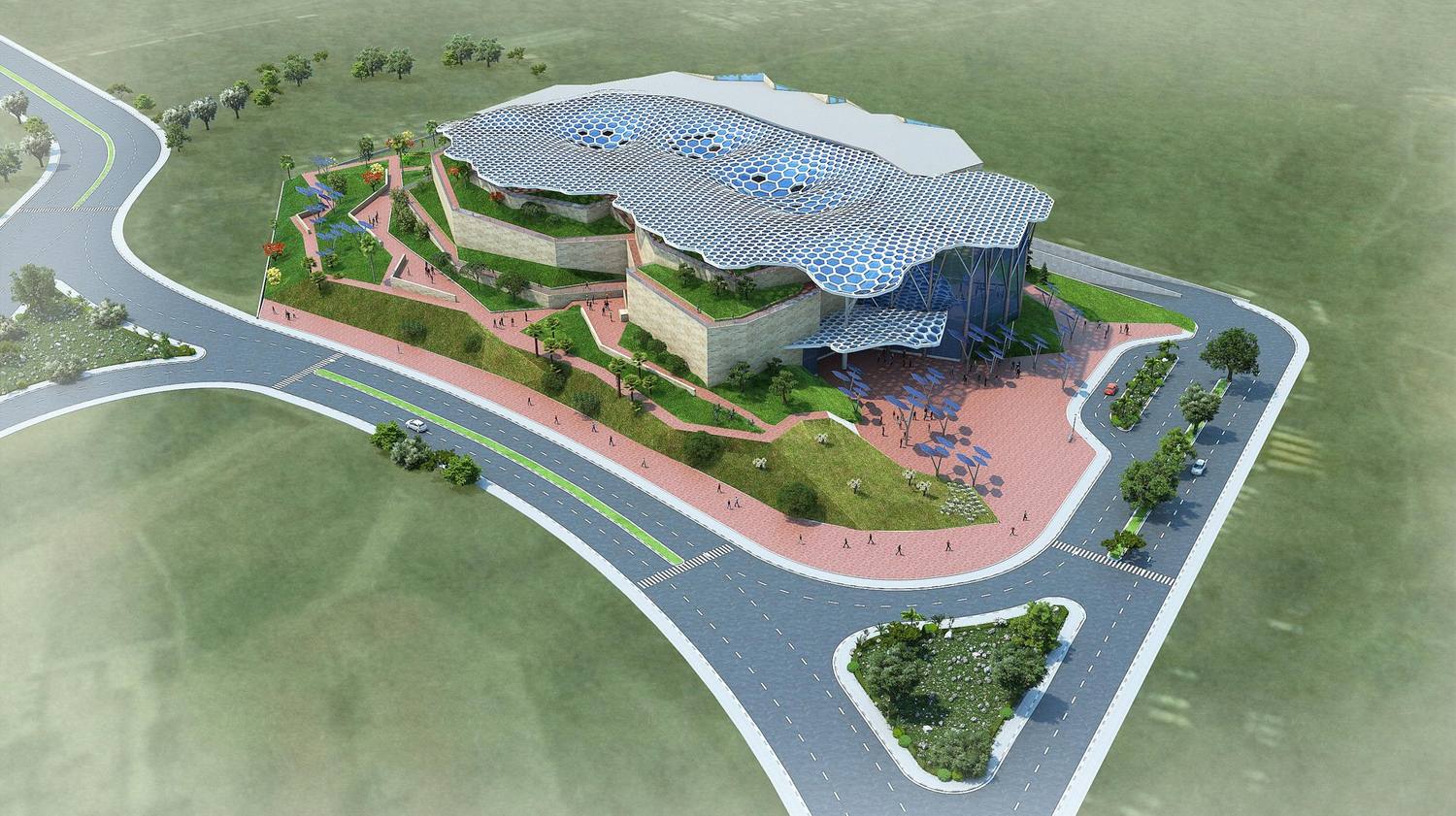
The Natural History and Biodiversity Museum is built around a single idea: that the building itself should tell part of the story it houses. Glass, steel and planting are set against one another, and the line between inside and outside is deliberately blurred. The visit begins in a tall central atrium, crowned by a hexagonal canopy whose pattern recalls a beehive or the canopy of a forest.
Under the roof
The canopy diffuses daylight gently into the interior. It also does practical work: it harvests rainwater, encourages cross ventilation and houses a mist system that cools the Interiors passively. Light, water and air are handled by the same structure, which is why it sits at the centre of the design.
In the main gallery, visitors meet life-size skeletons of a Tyrannosaurus rex and a woolly mammoth. They are placed as sculptural anchors for the Museum's central themes of evolution, extinction and ecological resilience. At the base of each, interpretive panels pair hand-drawn scientific diagrams with digital interfaces, so that a child and a scholar can read the same exhibit at different depths. Large LED screens hung through the galleries show ancient landscapes, ocean life and forest biomes.
Planted walls and indoor Courts
Vertical green walls climb the facades, a soft counterpoint to the precision of glass and steel. The transparent skin brings light into every level. Beyond the galleries, the Museum opens into indoor courtyards planted with native species, where water channels run beside the paths.
The cafeteria is designed as a forest glade. Trees rise through the dining tables, and canoe-shaped seating recalls a camp beside a prehistoric river. It is a place to sit and pause between galleries.
Reading the section
Seen in section, the building rises from a solid plinth at street level to planted terraces above. Mural panels of tigers, waterfalls, butterflies and endangered species run across the elevations. Read from the ground up, the profile moves from the fossil record at its base to living gardens on its terraces.
The project
National Museum of Natural History
New Delhi, Delhi
See the project