

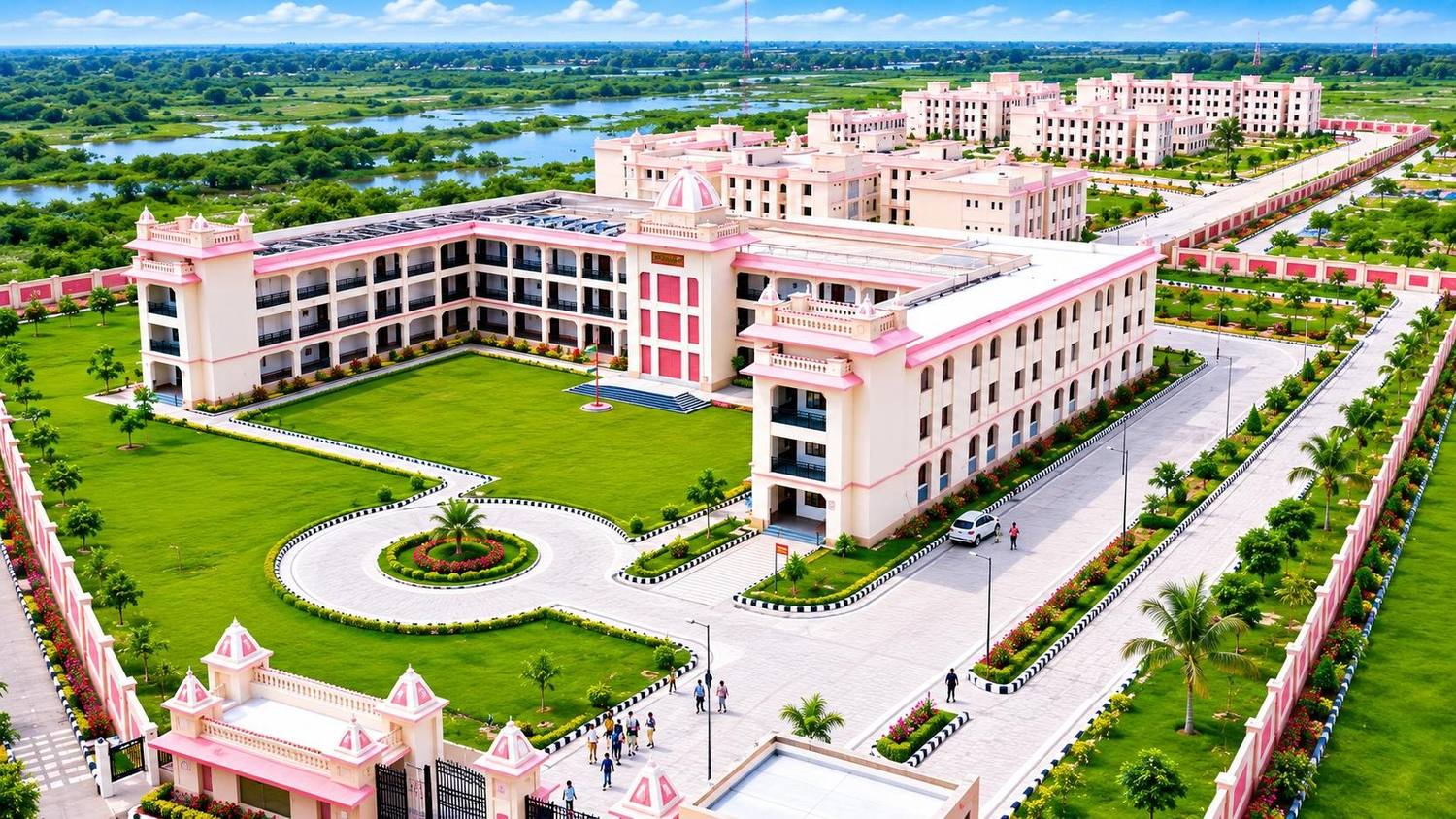
The Atal Residential Schools are boarding Schools on two Campuses in Uttar Pradesh, one in Lucknow and one in Ayodhya. Children live here as well as study here, so the design has to carry the whole day, from lessons to play, meals and rest. Both Campuses follow the same idea: classrooms, residences and open ground sit close together, and the landscape is treated as part of the School rather than the space left over between buildings.
The academic blocks
The academic blocks form the core of each Campus. Classrooms are generous and naturally ventilated, fitted with smart teaching aids, and they are joined by Libraries and Laboratories. Within this the plan makes room for different ways of learning: quiet reading corners for a child working alone, and open collaboration areas where a group can gather around a shared task.
Administrative spaces are woven into the same fabric rather than set apart. Staff, teachers and students work within sight of one another, and the openness of the plan is meant to support trust between them. The Campus is run more like a household than an office.
Living together
For boarding students the residences are home. They are planned as communities rather than as rows of dormitories, with rooms and corridors designed for warmth, comfort and safety. Students live, study and grow up alongside one another, and a sense of belonging matters here as much as the room itself.
Dining halls and kitchen blocks give the day its rhythm. Shared meals are one of the daily rituals of a residential School, and the dining hall is where the whole community meets.
Play, shade and green ground
Outside the classroom each Campus has playgrounds, indoor activity halls, yoga lawns and spaces for art, so that every child has somewhere to run, stretch, make things or simply be.
The landscape is handled with the same care. Existing trees have been retained, gardens are planted between the buildings, and shaded walkways lined with flowering creepers link one part of the Campus to the next. Water and energy are dealt with quietly: rainwater is harvested, water is recycled, the parking bays are solar powered, and materials were chosen for their low impact on the environment.
Two cities, one approach
The two Campuses share a way of working but answer different settings. In Lucknow the School belongs to a city, and its Planning reflects that urban context. In Ayodhya the Campus draws more on the town's cultural and spiritual character. In both, the design is measured by ordinary daily life: a classroom with good air, a walk in the shade, a meal shared with friends.
The project
Atal Residential School
Lucknow, Uttar Pradesh
See the project